


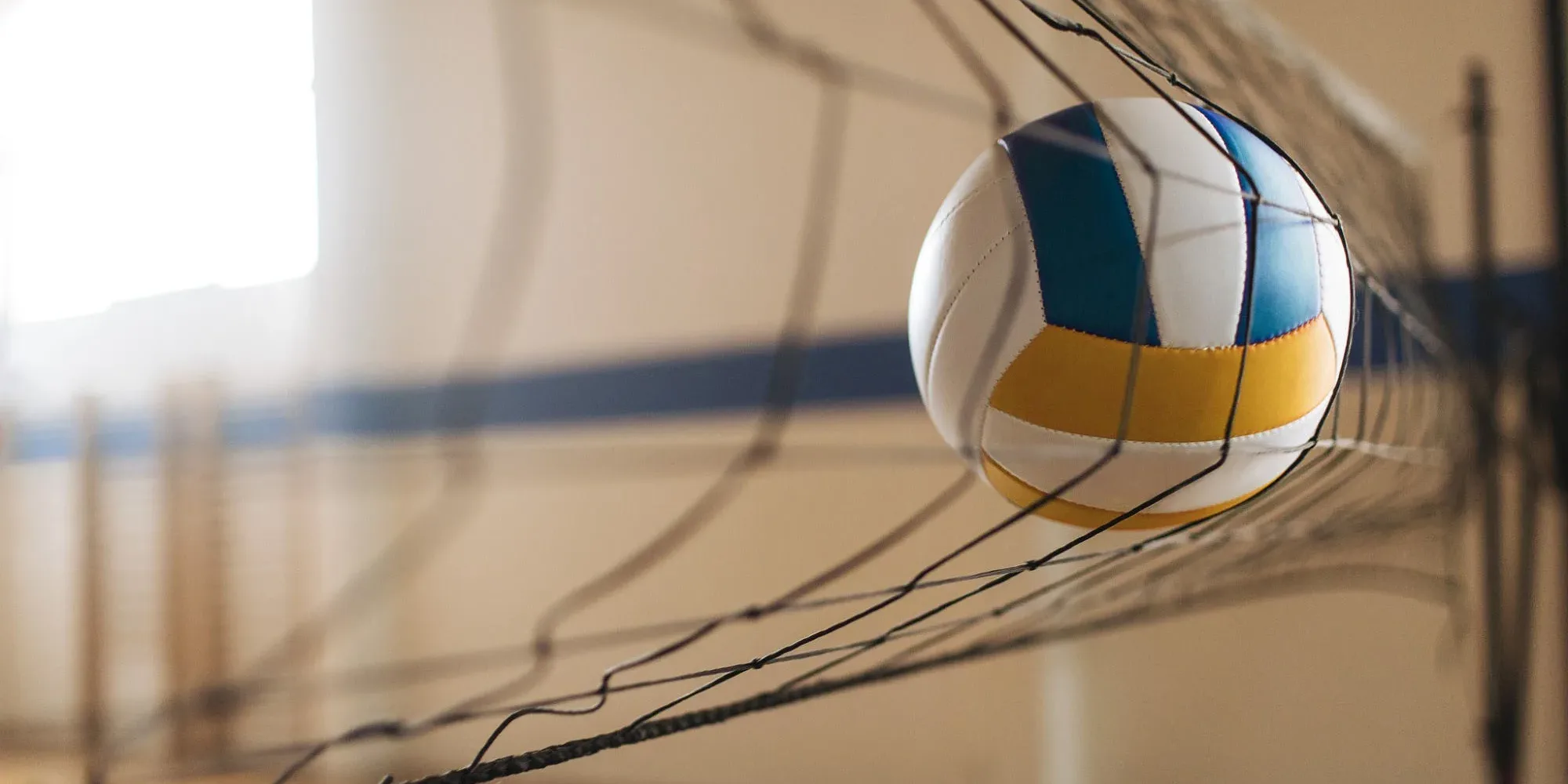
A well-built beach volleyball court is the difference between a game that plays true and one that fights you every rally. Whether you are kitting out a beach sports centre, a school field or a pop-up event, the same principles apply: the right dimensions, a properly prepared surface, and equipment matched to how permanent your setup needs to be. Get the groundwork right and the rest follows naturally, from boundary lines to the net itself. This guide walks through the full process step by step, so you can specify and build a court that holds up for casual play and tournaments alike.
What equipment do you need for a beach volleyball court?
Before any sand is raked, it helps to picture the full kit list. A complete beach volleyball setup is made up of courtlines, posts, ground sockets or anchors, a net, antennae, post padding and an umpire chair. You can buy these as separate components for a permanent installation, or as an all-in-one beach volleyball set that packs into a single carry bag for portable use.
The right combination depends on the site: a dedicated beach sports centre will want fixed posts in permanent sockets, while a school field or pop-up event is better served by a portable system that can be moved and stored. We supply the full Funtec range across both, so you can match the kit to the site.
In short: a full court needs courtlines, posts, sockets, a net, antennae, padding and an umpire chair, available as individual parts or a single set.

Step 1: What are the correct court dimensions?
A regulation beach volleyball court measures 16 metres long by 8 metres wide, a standard set by the FIVB (Fédération Internationale de Volleyball) and used everywhere from club play to the Olympics. Unlike indoor volleyball, there is no centre line and no attack line, so each team covers its full 8m × 8m half. Mark your boundary lines clearly, leave a free zone of at least 3 metres on all sides for recreational play (5 to 6 metres for competition), and you have a safe, fair playing area.
The surface matters just as much as the measurements. Aim for at least 40cm of fine, clean sand, free of stones, shells and debris, raked level before every session. Loose, well-sifted sand protects players as they dive and gives the consistent footing proper beach volleyball demands.
In short: build to 16m × 8m with a 3m-plus free zone, on a minimum of 40cm of clean, level sand.
Step 2: How do you lay out the courtlines?
Courtlines define the boundaries and are the quickest way to turn an open stretch of sand into a recognisable court. Our Funtec courtlines come pre-formed to regulation 16m × 8m dimensions with sturdy webbing and corner anchors, so you simply peg out the rectangle and tension the tapes. To keep the shape true, measure your diagonals as well as your sides; on a correct 16m × 8m court, both diagonals should read 17.89 metres.
We stock courtlines to suit every level. The competition-grade Pro Beach courtlines are built for tournament use and heavy footfall, while the budget-friendly Fun Volley court lines suit gardens, schools and casual play. Note that net sets are usually sold without courtlines, so it is worth adding a set from the outset.
In short: peg out a pre-formed line set to 16m × 8m, check the 17.89m diagonals, and choose a grade that matches your level of play.
Step 3: Which posts and sockets are right for your court?
Posts are the backbone of the court, and the choice comes down to how permanent your setup needs to be. For fixed installations such as beach centres, our Pro Beach competition posts are heavy-duty aluminium uprights used by national volleyball bodies worldwide. They adjust for height even under net tension, so you can switch between men’s, ladies’ and junior games at the turn of a knob, and they cope with changing sand levels across a season.
The fixing underneath is just as important. We offer a range of ground sockets and anchors, from bolt-down sockets for permanent courts to removable City Beach sockets for semi-permanent setups that can be lifted and relocated. As a rule, position posts between 0.5 and 1 metre outside the sidelines, never on the line itself, for both safety and FIVB compliance. For unsupervised public beaches, more vandal-resistant Beach Basic posts are the wiser choice.
In short: match aluminium competition posts to bolt-down or removable sockets, and set them 0.5–1m clear of the sidelines.
Step 4: How do you fit and tension the net?
With your posts in place, the net brings the court to life. Beach volleyball nets sit at 2.43 metres for men and 2.24 metres for women, measured at the centre, and a good net holds even tension across its full width without sagging. Our Funtec nets come in 8.5m and 9.5m widths to suit different post spacings, with heavy-duty tension straps and driven ground anchors to keep everything taut.
Antennae fitted directly above each sideline complete the net, marking the vertical plane the ball must cross to stay in play. If you prefer a single purchase, our portable net sets bundle posts, net, anchors and a carry bag, ready to pitch on sand or grass in minutes.
In short: tension a competition net to 2.43m (men) or 2.24m (women), add antennae over the sidelines, or buy a complete net set for speed.
Step 5: What safety and officiating extras should you add?
A professional court is finished off with the details that protect players and support officiating. Post padding is the first priority: our beach volleyball post protector pads and outdoor post pads wrap the uprights to cushion collisions during fast rallies.
For matches and tournaments, an umpire chair gives the official a clear, elevated view of the whole court. Our aluminium umpire chair is lightweight, maintenance-free and easy to move or store, with wide non-slip steps and a writing desk for scoring, equally at home on a beach court or a tennis court. Add spare anchors and a storage bag, and your setup is genuinely match-ready.
In short: finish with post padding and an umpire chair to keep play safe and the competition running smoothly.
Can one system handle beach volleyball, tennis and other sports?
Yes, and this is where a modular setup earns its keep. The Funtec post and socket systems are multi-sport, so the same sockets that hold your volleyball posts can take posts for beach tennis, beach handball and footvolley. Switch the net and height, and one court becomes a flexible facility, ideal for clubs and councils making the most of limited space.
The crossover extends to your accessories. The same aluminium umpire chair works across volleyball and tennis, and if you are building a wider racket and net offering, our tennis range covers nets, tennis posts and court equipment to complement your beach setup.
In short: Funtec systems convert between beach volleyball, beach tennis and other net sports, sharing sockets and accessories.
Beach volleyball net sets compared
If you would rather buy a complete set than source parts separately, our most popular Funtec net sets step up in capability as you move through the range. The entry point is the Fun Beach Volleyball Set, built on lightweight plastic posts and supplied in a single width, which makes it ideal for gardens, schools and casual play. One step up, the Beach Masters Net Set uses a more durable composite construction and comes in 8.5m and 9.5m widths, suiting school sport and entry-level tournaments.
For something closer to match standard, the Beach Champ Net Set pairs height-adjustable plastic posts with the same 8.5m and 9.5m net options, giving clubs a genuine competition feel on a sensible budget. At the top of the range, the Pro Beach Net Set is built on competition-grade aluminium and is the choice for serious clubs and dedicated beach sports centres, again available in 8.5m and 9.5m widths.
Frequently asked questions
What is the standard size of a beach volleyball court? A regulation court is 16 metres long by 8 metres wide, with a free zone of at least 3 metres on all sides. There is no centre line or attack line, so each pair covers its full half.
How high should a beach volleyball net be? The net is set at 2.43 metres for men and 2.24 metres for women, measured at the centre. Junior and recreational games often lower this.
Can I set up a Funtec court on grass instead of sand? Yes. Many portable sets use driven ground anchors suitable for both sand and soil, so they work well on grass pitches, gardens and multi-use areas as well as the beach.
Do net sets include courtlines? Usually not. Most beach volleyball net sets are supplied without courtlines, so we recommend adding a separate set to mark out your 16m × 8m boundary.
Ready to build your court?
Whether you are kitting out a beach sports centre, a school field or a club court, we can supply everything from courtlines and posts to nets, padding and umpire chairs, with expert advice to help you specify the right system first time. As the UK agent and installer of Funtec beach sports equipment, we can also handle permanent installations from start to finish.
Browse the full beach volleyball range or get in touch with our team for a tailored quote. Call us on 08000 197 733 or email sales@sportsmark.net, and let’s get your court ready for the season.
Sources and further reading
- FIVB Official Beach Volleyball Rules (court dimensions, net heights and free-zone requirements)
- Olympics.com – Beach volleyball rules and court specifications
- Funtec beach sports product documentation
- Our full beach volleyball equipment range and wider beach sports collection
